A meeting room must often accommodate more than one type of activity, from departmental discussions and client consultations to temporary training sessions. Furniture that can adapt to these changing demands gives businesses greater control over how their working environments are used.
A folding design offers a different level of flexibility from conventional fixed furniture, particularly when meeting requirements change throughout the week. For businesses assessing a flip top conference table, the distinction lies in its folding mechanism, operational convenience, and ability to support different workplace arrangements. Leadcom Seating provides furniture options that reflect these practical considerations.
Flexible Use Across Different Workplace Activities
A fixed meeting table generally retains the same configuration regardless of the activity taking place. Although this arrangement works well for dedicated boardrooms, it may be less suitable for multipurpose rooms where attendance and working requirements vary. Folding tables introduce another option by allowing their usable configuration to change according to immediate needs.
Training sessions, temporary project meetings, and group workshops often require different furniture arrangements. A folding mechanism can make it easier to prepare a room for these activities without relying on permanently assigned furniture. Once the session finishes, the table can be folded or repositioned according to the next scheduled use.
The distinction between folding and fixed designs becomes particularly relevant in offices with shared facilities. A flip top conference table can provide an alternative for businesses that need adaptable meeting surfaces, although the specific mechanism and folding direction should be evaluated before selection.
Easier Handling and Furniture Reconfiguration
The practical value of folding furniture depends partly on how easily staff members can operate its mechanism. A well-designed folding system should allow the tabletop to move through its intended range without requiring complicated procedures. Locking components also play an important role because they help keep the table in its designated position during use.
Mobility is another consideration. Some folding tables incorporate wheels or other movement features, allowing staff to reposition furniture without repeatedly lifting heavy components. The suitability of these features depends on floor conditions, table weight, and the frequency of room changes.
Storage arrangements should receive similar attention. A folded table may occupy less usable floor area than an assembled unit, but its actual storage requirements depend on its dimensions and folding profile. Businesses comparing a flip top conference table with a standard fixed design should examine both its operating mechanism and the space needed to store it safely.
Table Dimensions and Ergonomic Requirements
Adaptability should not come at the expense of participant comfort. Table height, depth, and working-surface dimensions influence posture, seating compatibility, and the amount of room available for individual activities. These measurements should correspond to the chairs being used and the average duration of meetings.
The relationship between table dimensions and participant numbers also deserves attention. A surface that is too narrow may restrict access to documents and electronic devices, while excessive depth can make shared materials difficult to reach. Appropriate proportions help participants maintain comfortable working positions during discussions.
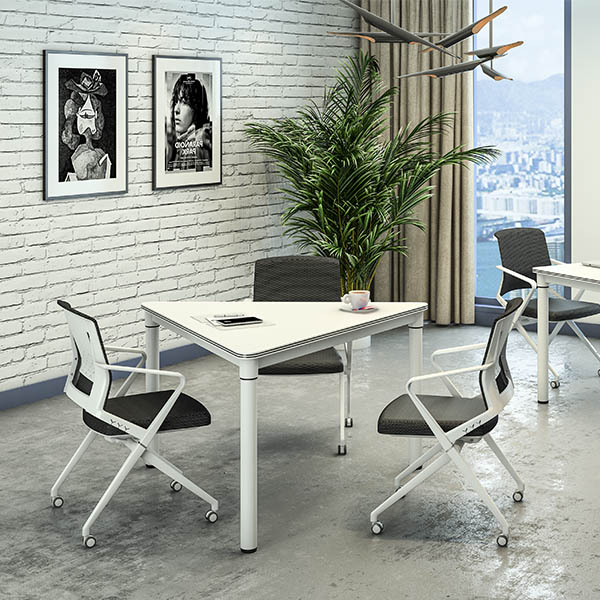
The HARRIS MT LS-4-20MT Fixed-top Meeting Table from Leadcom Seating provides a reference for understanding these dimensional considerations. Its metal frame has an adjustable specification range of 940–1140 mm in both length and depth, with a height of 725 mm. These measurements illustrate how tabletop proportions and working height can be assessed when planning furniture for professional meeting environments.
Construction Features and Everyday Operational Safety
The folding mechanism is only one part of a table’s overall functionality. Its supporting frame, connection points, locking system, and tabletop construction all influence how the furniture performs during regular use. Particular attention should be given to joints and moving components because these areas experience repeated mechanical movement.
Material selection also affects handling and maintenance. Metal frames are commonly used in commercial furniture because they provide structural support, while engineered wood surfaces offer a practical working area for documents and electronic equipment. The combination should be evaluated according to the intended load and operating conditions.
Safety procedures are equally important in multipurpose environments. Staff should follow the manufacturer’s instructions when folding, unfolding, moving, or storing tables. Pinch points, unlocked mechanisms, and uneven floor surfaces can create avoidable handling risks. A flip top conference table should be assessed not only by its folding convenience but also by the reliability of its supporting and locking components.
Conclusion
The main distinction between folding and standard fixed meeting tables concerns how each design responds to changing workplace requirements. Folding mechanisms can simplify furniture handling, support temporary room arrangements, and reduce the amount of floor space occupied during storage. Fixed designs, meanwhile, remain suitable for meeting environments with stable layouts and predictable usage patterns.
Leadcom Seating illustrates the range of construction and dimensional considerations involved in commercial meeting furniture. Before selecting a particular configuration, businesses can assess operating frequency, participant comfort, storage conditions, and mechanical safety together. A suitable flip top conference table should match the actual demands of the working environment rather than simply offer a folding feature as an additional specification.
